


Page 14 - ASCO Cultural Competency Toolkit
P. 14
CURRICULAR INTEGRATION AND TEACHING STRATEGIES
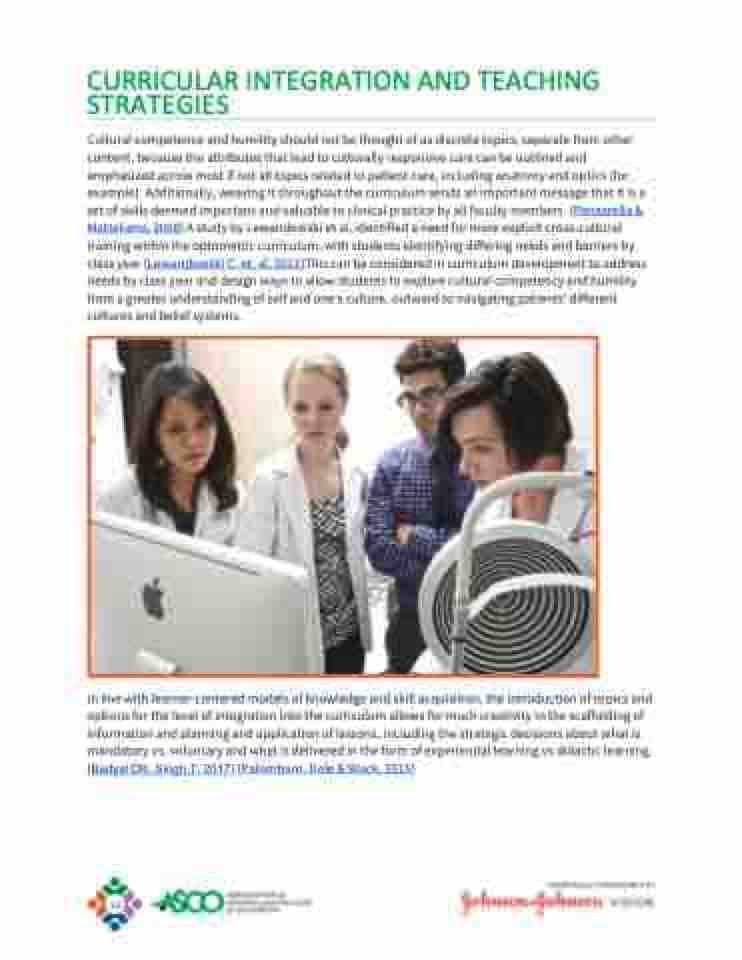
Cultural competence and humility should not be thought of as discrete topics, separate from other content, because the attributes that lead to culturally responsive care can be outlined and emphasized across most if not all topics related to patient care, including anatomy and optics (for example). Additionally, weaving it throughout the curriculum sends an important message that it is a set of skills deemed important and valuable to clinical practice by all faculty members. (Panzarella & Matteliano, 2008) A study by Lewandowski et al. identified a need for more explicit cross-cultural training within the optometric curriculum, with students identifying differing needs and barriers by class year (Lewandowski C. et. al, 2021)This can be considered in curriculum development to address needs by class year and design ways to allow students to explore cultural competency and humility from a greater understanding of self and one's culture, outward to navigating patients’ different cultures and belief systems.
In line with learner-centered models of knowledge and skill acquisition, the introduction of topics and options for the level of integration into the curriculum allows for much creativity in the scaffolding of information and planning and application of lessons, including the strategic decisions about what is mandatory vs. voluntary and what is delivered in the form of experiential learning vs didactic learning. (Badyal DK, Singh T, 2017) (Palombaro, Dole & Black, 2015)
           GENEROUSLY SPONSORED BY
  12


