


Page 19 - ASCO Cultural Competency Toolkit
P. 19
Societal
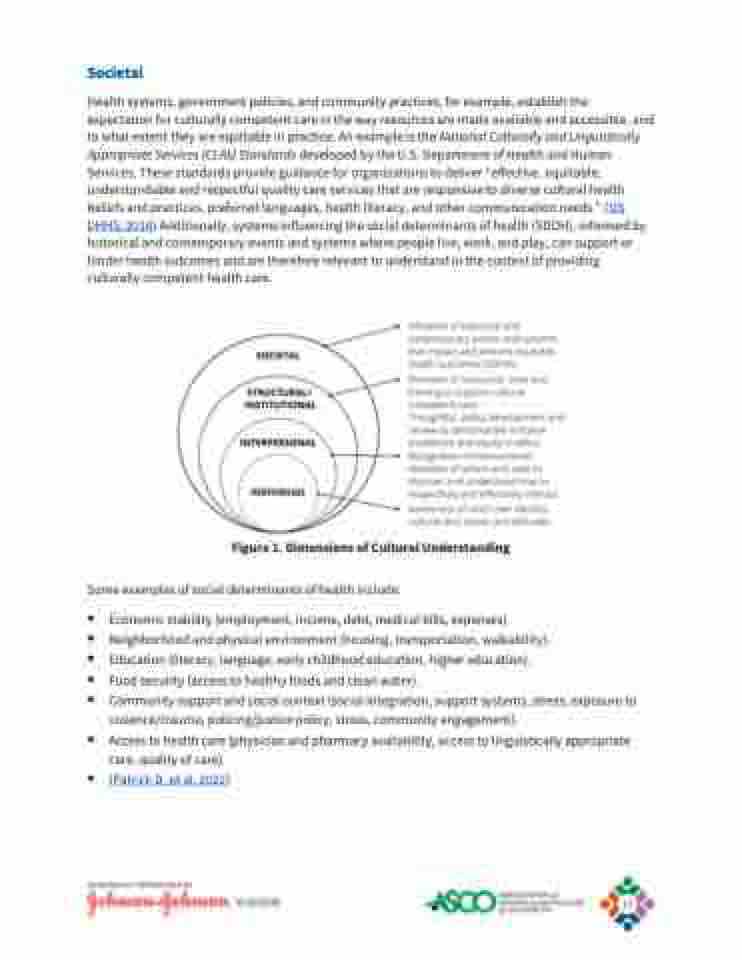
Health systems, government policies, and community practices, for example, establish the expectation for culturally competent care in the way resources are made available and accessible, and to what extent they are equitable in practice. An example is the National Culturally and Linguistically Appropriate Services (CLAS) Standards developed by the U.S. Department of Health and Human Services. These standards provide guidance for organizations to deliver “effective, equitable, understandable and respectful quality care services that are responsive to diverse cultural health beliefs and practices, preferred languages, health literacy, and other communication needs.” (US DHHS, 2016) Additionally, systems influencing the social determinants of health (SDOH), informed by historical and contemporary events and systems where people live, work, and play, can support or hinder health outcomes and are therefore relevant to understand in the context of providing culturally competent health care.
Figure 1. Dimensions of Cultural Understanding
Some examples of social determinants of health include:
▪ Economic stability (employment, income, debt, medical bills, expenses).
▪ Neighborhood and physical environment (housing, transportation, walkability).
▪ Education (literacy, language, early childhood education, higher education).
▪ Food security (access to healthy foods and clean water).
▪ Community support and social context (social integration, support systems, stress, exposure to
violence/trauma, policing/justice policy, stress, community engagement).
▪ Access to health care (physician and pharmacy availability, access to linguistically appropriate
care, quality of care).
▪ (Patrick D, et al. 2022)
    GENEROUSLY SPONSORED BY
  17


