


Page 26 - ASCO Cultural Competency Toolkit
P. 26
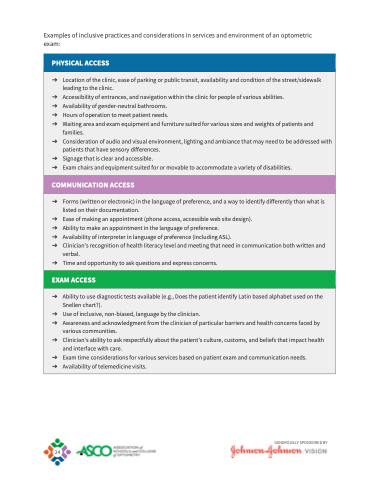
Examples of inclusive practices and considerations in services and environment of an optometric exam:
   PHYSICAL ACCESS
    ➔ Location of the clinic, ease of parking or public transit, availability and condition of the street/sidewalk leading to the clinic.
➔ Accessibility of entrances, and navigation within the clinic for people of various abilities.
➔ Availability of gender-neutral bathrooms.
➔ Hours of operation to meet patient needs.
➔ Waiting area and exam equipment and furniture suited for various sizes and weights of patients and
families.
➔ Consideration of audio and visual environment, lighting and ambiance that may need to be addressed with
patients that have sensory differences.
➔ Signage that is clear and accessible.
➔ Exam chairs and equipment suited for or movable to accommodate a variety of disabilities.
      COMMUNICATION ACCESS
    ➔ Forms (written or electronic) in the language of preference, and a way to identify differently than what is listed on their documentation.
➔ Ease of making an appointment (phone access, accessible web site design).
➔ Ability to make an appointment in the language of preference.
➔ Availability of interpreter in language of preference (including ASL).
➔ Clinician’s recognition of health literacy level and meeting that need in communication both written and
verbal.
➔ Time and opportunity to ask questions and express concerns.
      EXAM ACCESS
    ➔ Ability to use diagnostic tests available (e.g., Does the patient identify Latin based alphabet used on the Snellen chart?).
➔ Use of inclusive, non-biased, language by the clinician.
➔ Awareness and acknowledgment from the clinician of particular barriers and health concerns faced by
various communities.
➔ Clinician's ability to ask respectfully about the patient's culture, customs, and beliefs that impact health
and interface with care.
➔ Exam time considerations for various services based on patient exam and communication needs.
➔ Availability of telemedicine visits.
     GENEROUSLY SPONSORED BY
  24


