


Page 76 - Index
P. 76
Appendix 2
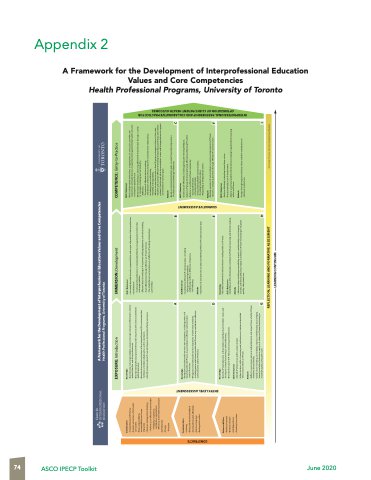
A Framework for the Development of Interprofessional Education Values and Core Competencies
Health Professional Programs, University of Toronto
                    74
ASCO IPECP Toolkit
June 2020
Collaboration
EXPOSURE: Introduction Knowledge
IMMERSION: Development Skill / Behaviour
COMPETENCE: Entry-to-Practice Skill / Behaviour
• Interprofessional (IP) theory
• Context and culture of the health
• Describe own role, responsibilities, values and scope of practice effectively to clients/ patients/families and other professionals.
• Accurately describe the roles, responsibilities and scopes of practice of other professions. • Contribute to:
• Work collaboratively with others, as appropriate, to assess, plan, provide care/ intervention and make decisions to optimize client/patient/family health outcomes and improve quality of care.
care system
• Roles, responsibilities,
• Describe interprofessional practice theory with respect to the science and theories behind teamwork.
- Involving other professions in client/patient/family care appropriate to their roles and responsibilities.
• Demonstrate leadership in advancing effective IP team function through a variety of strategies including, but not limited to:
- Reflection,
- Promotion of effective decision-making,
accountabilities and scope
of practice
• Decision-making/critical thinking
- Perform as an effective team member
• Describe the context and culture of the interprofessional (IP) environment that facilitates or inhibits collaboration, and its constraints.
- Effective decision-making in IP teamwork utilizing judgment and critical thinking. - Team effectiveness through reflection on IP team function.
- The establishment and maintenance of effective IP working relationships/
-- Flexibility, cooperation, contribution, organization/ efficiency, team health maintenance
partnerships.
- Flexibility and adaptability,
- Able to assume diverse roles in their IP group and support others in their roles,
- Establish and maintain effective IP working relationship partnerships with clients/
• Self-reflection • Change
patients/ families and other team members, teams and/or organizations to support achievement of common goals.
- Proactive
Attitude
Communication
• Recognize and understand how one’s own uniqueness, including power and hierarchy within the IP team, may contribute to effective communication and/or IP tension.
• Contribute to effective IP communication, including: - Giving and receiving feedback,
- Addressing conflict or difference of opinions,
- Self-reflecting.
• Communicate effectively, including giving and receiving feedback.
• Advance IP group functioning through effectively addressing IP conflict. • Perform as an effective IP team member by:
• Listening
• Giving and receiving feedback • Sharing information effectively • Common language
• Dealing with conflict
• Recognize and understand how the uniqueness of other team members, including power and hierarchy within the IP team, may contribute to effective communication and/or IP tension.
Attitude
- Sharing information,
- Listening attentively,
- Using understandable communications, - Providing feedback to others,
- Responding to feedback from others.
Values and Ethics
• Describe IP team dynamics as they relate to individual team members' values and the impact on team functioning in ethical dilemmas.
• Describe frameworks for ethical decision-making within an IP team.
• Perform effectively to develop shared team values.
• Practice ethically in an IP environment.
• Able to use a framework for ethical decision-making to guide ethical reasoning
• Relational-centred
• Diversity sensitive
• Interdependence
• Creativity/innovation
• Describe the nature of IP ethical reasoning and justification.
Skill / Behaviour
Knowledge
Skill/Behaviour
Skill / Behaviour
Knowledge
Knowledge
Skill / Behaviour
Skill / Behaviour
Attitude
within an IP team.
A Framework for the Development of Interprofessional Education Values and Core Competencies
Health Professional Programs, University of Toronto
• Identify instances where IP care will improve client/patient/family outcomes.
- Identification of factors that contribute to or hinder team collaboration, including power and hierarchy,
• Identify IP ethical issues within a team context.
• Utilize the basic skills of reasoning and justification as it relates to identified
• Advance values including accountibility, respect, confidentiality, trust, integrity, honesty and ethical behaviour, equity as it relates to IP team functioning to maximize quality, safe patient care.
Attitude
ethical issues within an IP team.
• Accept, through respect and value, others and their contributions in relational-centred care.
Attitude
• Reflect on own values, personal and professional, and respect those of other IP team members/clients/families.
• Clarify values including accountibility, respect, confidentiality, trust, integrity,
honesty and ethical behaviour, equity as it relates to IP team functioning to
maximize quality, safe patient care. G
H
I
A
B
• Based on client/patient/family needs, consider that preferred practice is
IP collaboration and willingly collaborate. C
D
E
• Develop awarness of and contribute to continual improvement of IP team
dynamics and group processes through effective IP communication. F
• Awareness of and openness to utilize and develop effective IP communication skills.
• Guided by an ethics framework, contribute to IP ethical reasoning and decision-making.
REFLECTION, LEARNING AND FORMATIVE ASSESSMENT
© University of Toronto, Centre for Interprofessional Education
LEARNING CONTINUUM
Attitude
CONSTRUCTS
ENTRY-LEVEL ASSSESSMENT
SUMMATIVE ASSESSMENT
INTERPROFESSIONAL PARTNERSHIP AND COLLABORATIVE PRACTICE FOR OPTIMIZATION OF CLIENT/PATIENT HEALTH OUTCOMES


