
Section 3: Resources/Activities for Students in Between Patient Care
Independent Study
During gap time between patients, students can do the following:
- Read required journal article reviews, then provide synopsis
- National Library of Medicine
- PubMed
- Online case reviews with embedded quizzes
- Eye and Contact Lens Association, Inc (ECLA/CLAO) – curriculum for ophthalmology residents
- Digital Journal of Ophthalmology
- Digital Reference of Ophthalmology
- Semester Project: This can be assigned to students to research further on an interesting case or address a public health issue. For example, there could be a recent burst of teenagers purchasing unprescribed contact lenses, and a student develops methods of patient education to help them to understand the importance of a full contact lens fitting.
- A fun Binocular Vision Semester project: To design a vision therapy exercise, i.e. a board game, a card game, a puzzle, using what was learned in class and in clinic so that it can then be used by others in the future. This not only pushes your student clinician to design something with active didactic forethought but also expands the capability of your clinic’s vision therapy activity options.
- Don’t forget to ask for playing/demonstration instructions to be left behind with each project
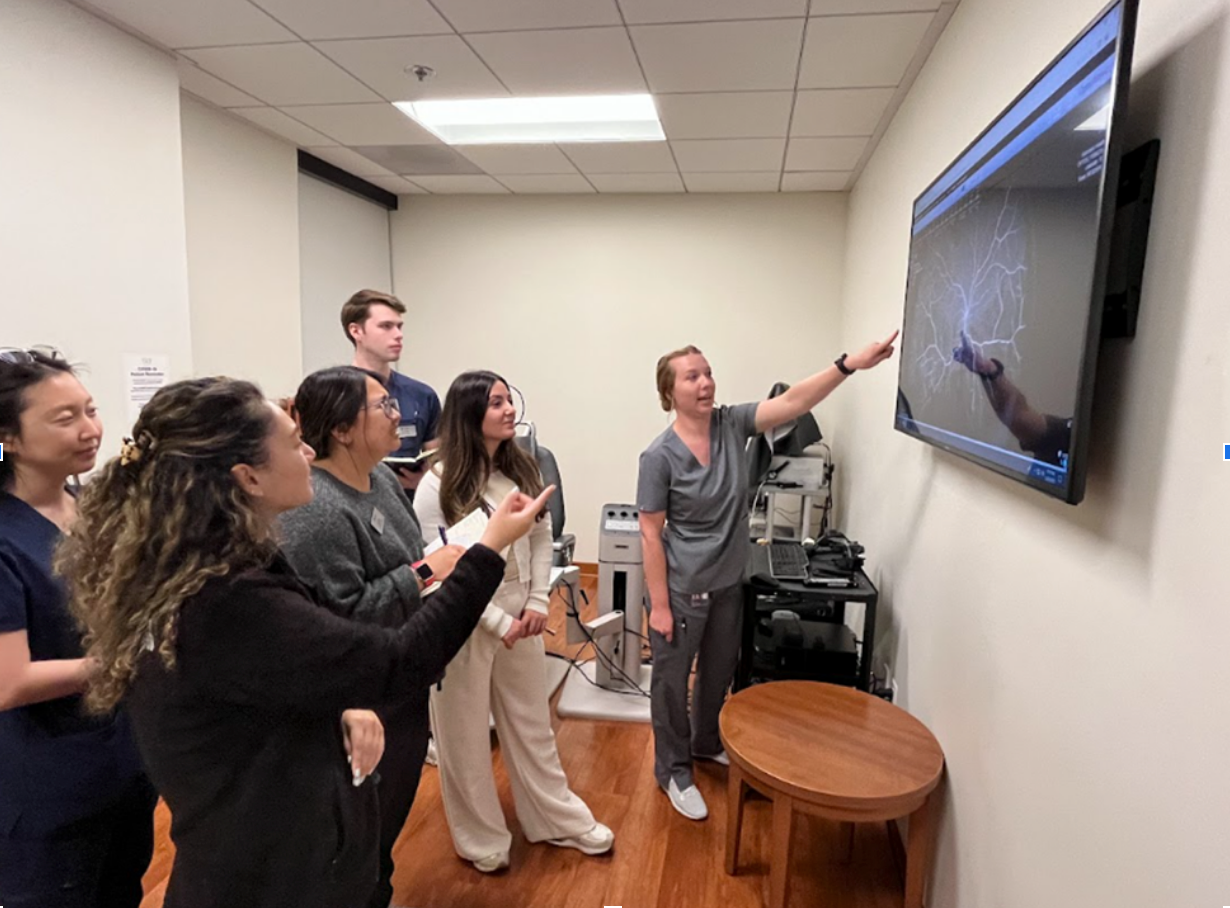
Image source: J. Nishimoto, Ketchum University SCCO
Preceptor Pearl: When assigning projects or assignments, keep in mind the student’s general workload, timing of midterm and final exams, and other factors in their schedule.
Journal Club
Journal Clubs: Discussion on latest clinical trials or landmark studies; these journal sessions are best performed during a lunch and learn regular session, or during a blocked off time. The rounds can be led by a preceptor or resident. New preceptors can collect journal articles and discussion questions over time, or access online case websites for Optometry and Ophthalmology.
- Resources for discussion of case presentation:
- NECO’s Journal Club Portal (open to public)
- NECO Resource for Journal Clubs, with teaching “packets” by disease topic
- NEI Clinical Trials
- Optometric Case Bank Discussions for improving case presentation and writing management plans (Moy A, Reilly J, Pham L)
- ASCO Teaching Case Reports from Journal of Optometric Education
- Resources for pre-written cases:
Preceptor Pearl: The best types of journal articles are well-referenced, well-organized, and use language that students can follow. Collect a variety of articles that address “hot topics” for conditions you often see in your clinic. You can keep them electronically or in a folder to use when there is downtime or a planned journal club session.
Peer Learning
Similar to Journal club and case discussions; have your students pick a topic every week and do a small presentation regarding a patient or general learning points they’d like to share. Having this sense of accountability to teach their colleagues and effectively their preceptor allows for independent learning and clinical maturing.
Case Presentations/Discussions
- An example of instructions for final year students to prepare for a case presentation at the end of their clinical rotation that semester (courtesy of Dr. Benjamin Young, NECO) https://drive.google.com/file/d/1CEwc9MTYQkGUtO5_vvxAiTFXBgwJL03M/view?usp=sharing
- Review of topics in SOAP format for case discussion:
- Pediatrics
- Binocular Vision
- Exams for patients with disabilities
- Primary Care/Ocular Disease
- RX recheck scenarios
- Difficult patient scenarios
- Ethical Dilemmas
- Role-playing (clinician vs patient)
- ASCO’s SOCCEP Case Presentations for remote learning
Small Group Activities
These discussions are to supplement the direct patient care experience when there are less patients. The time frame can be 15 minutes to one hour, depending on the time allotted.
Required Technical skill/patient encounter types
- “Skill of the month” to be signed off by preceptor
- ie. Various forms of tonometry, gonioscopy, 3-mirror retinal eval, scleral depression, punctal plugs, foreign body removal, double lid eversion, contact lens fit, etc.
- “Skill Roulette”/Round Robin among the students in your cohort
- Pair off students and round robin a skill such as gonio or tono under a set timeframe. Skill Roulette ends when everyone has had a turn.
- Perform exams on each other – with specific procedures in mind. Examples:
- Ocular Disease
- OCT
- FAF
- Scleral Depression
- Gonioscopy
- Threshold VFs
- Topics to discuss in patient SOAP format
- A/B Scan
- Contact Lenses
- Fitting specialty fits (Sclerals, Multifocals)
- Corneal Topography
- Binocular Vision Evaluation (visual efficiency evaluation)
- Perceptual evaluation
- Low Vision
- Practice vision simulation evaluations and use of magnifiers
- Bioptic workshop
- Review of drivers license form completion
- Watch visually-impaired influencers on TikTok
- Ocular Disease
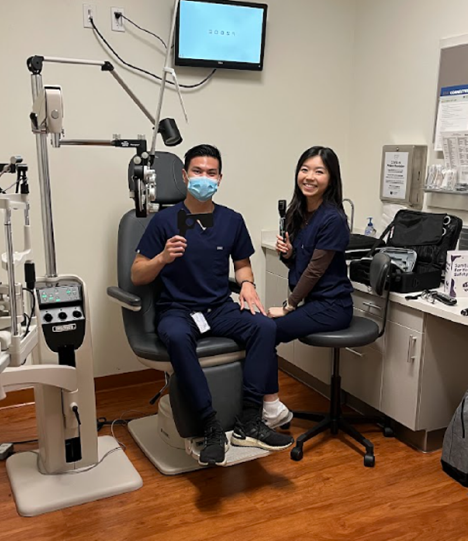
Image from Ketchum SCCO
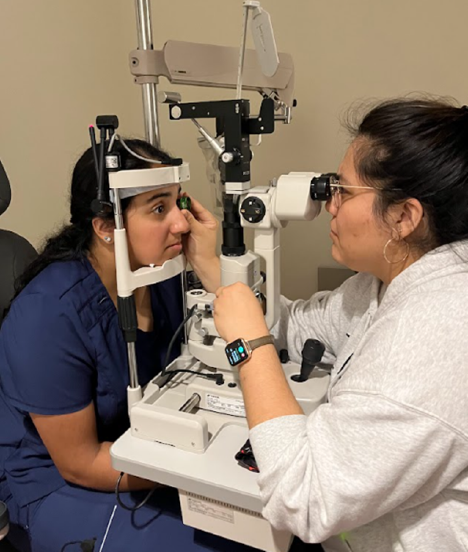
Image from Ketchum SCCO
Questions of the Day
- Preceptors can provide questions at the beginning of a clinical session, spanning various topics that are clinically relevant (i.e. ocular disease pathophysiology/management/treatment, binocular vision therapies, pediatric disease, contact lens calculations)
- Each student can pick these questions at random and answer them. This can also start small group discussions. Questions can be also used during downtime in clinic
Use of technology for learning and communication
- Video technology (Zoom, Teams, etc) to observe student patient care synchronously
- Use of instant messaging within EHR or other approved secure methods
- Use of polling in case review sessions (Kahoot, Poll Everywhere, etc)
- Boards Review games/quizzes (Jeopardy, Who Wants to Be a Millionaire, pre-quiz and post-quiz during the semester)
- After recorded eye exam or practical, make clinical videos available to students for review and self-assessment
- Making videos to help with procedural skills
- Making videos for role modeling a patient exam
- Making videos of student doing exam skills (with fellow student) and getting feedback from preceptor
- Establish method for peer-to-peer feedback
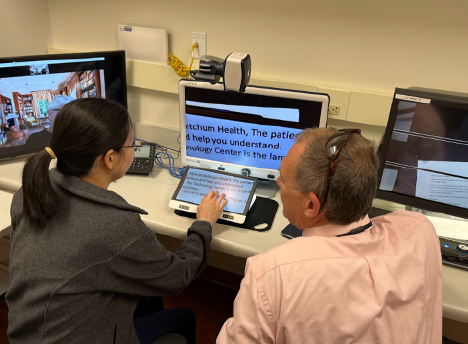
Image courtesy of Marshall B Ketchum University Southern California College of Optometry
Optometry Olympics
Have “events” that measure time and accuracy in areas such as: retinoscopy, lensometry, retinal image interpretation, writing a comprehensive assessment and plan, etc. It can be fun to have medals for those who do best in each event, or best overall medal. It is important to emphasize that this is not part of their grade, but a good self-assessment for skills and efficiencies to work on.
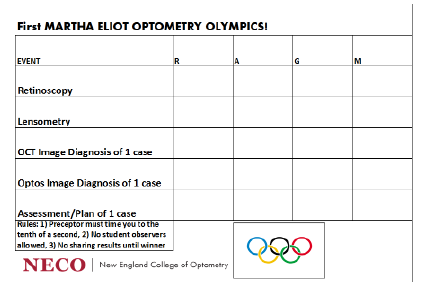
Example form designed by A. Moy, NECO