
Herbert Wertheim Award
Nomination period is currently closed.
This award, affectionately called the “Herbie,” recognizes remarkable individuals or organizations that have accomplished high-impact, ground-breaking, and innovative programs or initiatives, and contributed substantially, or have the potential to sustainably address, eye and vision health and/or the social determinants of eye health and vision care, at the local, national, or global level.
2026 Recipient
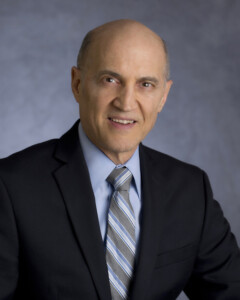
Dr. Mitchell M. Scheiman, is Senior Associate Dean of Research and Professor of Optometry at the Pennsylvania College of Optometry at Drexel University. An internationally recognized clinician-scientist in binocular vision and pediatric optometry, Dr. Scheiman has devoted his career to advancing the understanding, diagnosis, and treatment of binocular vision disorders, amblyopia, and vision problems associated with concussion.
Over more than four decades in academic optometry, Dr. Scheiman has played a leading role in developing the evidence base for vision therapy and binocular vision care. He served as Study Chair of the National Eye Institute, funded Convergence Insufficiency Treatment Trial and the Convergence Insufficiency Treatment Trialthe –Attention and Reading Trial (CITT-ART), landmark multicenter studies that established effective treatments for symptomatic convergence insufficiency in children. He currently serves as National Study Chair for a Department of Defense–funded clinical trial investigating vision dysfunction following concussion.
Dr. Scheiman has authored more than 265 scientific publications and several influential textbooks, including Clinical Management of Binocular Vision, one of the most widely used references in optometric education and clinical practice. His research has been cited more than 20,000 times and has helped shape clinical guidelines and standards of care for binocular vision disorders.
In addition to his research contributions, Dr. Scheiman has mentored numerous PhD students, residents, and early-career investigators, helping train the next generation of clinician-scientists in vision science. His many honors include the Glenn A. Fry Award from the American Academy of Optometry and induction into both the American Academy of Optometry and American Optometric Association Halls of Fame.
2025 Recipient
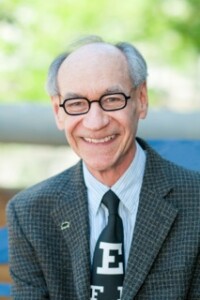
Dr. Dennis M. Levi is an American Professor at the University of California, Berkeley with appointments in the Herbert Wertheim School of Optometry & Vision Science, and the Helen Wills Neuroscience Institute. His research focuses on how we see form and depth, and how these are impacted by abnormal early visual development, particularly amblyopia and strabismus. He has published more than 300 scientific papers and two books. His work has been cited almost 30,000 times and he has an h-index of 87 (Google Scholar). His research has been funded by the National Eye Institute (NEI) since 1976.
Dr. Levi was born and grew up in East London, South Africa. He received his diploma in Optometry in 1967 from the Witwatersrand School of Optometry, in Johannesburg, South Africa. After practicing Optometry in Johannesburg and Vereeniging in Gauteng Province, South Africa, he and his new bride, Marilyn moved to Houston, Texas where he earned the OD in 1971, MS (Physiol. Optics) in 1973, and PhD (Physiol. Optics) in 1977 from the University of Houston.
He started his academic career at the University of Houston in 1972 as an Instructor in Optometry and progressed through the ranks becoming Full Professor in 1982. He served as the Associate Dean for Research from 1990-2001 and was awarded the University’s highest honor, Cullen Distinguished Professor in 1996. In 2001, he joined the University of California, Berkeley serving as the Dean of the School of Optometry until 2014. He is currently a Distinguished Professor of Optometry at UC Berkeley.
Among his many service activities Dr. Levi served as Chair of the National Eye Institute Vision Science B Study section and more recently on the National Advisory Eye Council. Dr. Levi has, and continues to serve on a number of editorial boards including Vision Research, Journal of Vision, Ophthalmic & Physiological Optics, Annual Reviews of Vision Science and Scientific reports. He was Editor in Chief of Vision Research and Journal of Vision, and began a new 5-year term as Editor-in-Chief of Journal of Vision in 2023.
Video presented during 2025 Annual Business Meeting
2024 Recipient
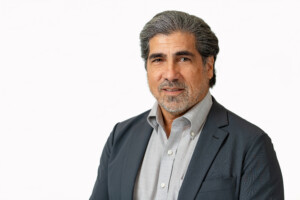
Dr. Jorge Cuadros is the founder of EyePACS, a program used for detecting retinal and systemic disease in over 1000 community health centers providing over 1.3 million telemedicine based retinal exams. His interest in ocular telehealth and community health over the past thirty years has led to programs for underserved populations in Latin America, Asia, Africa, and throughout the U.S. He has collaborated in hundreds of publications on digital heatlh and is co-author and co-editor of three books, “Teleophthalmology” and “Digital Teleretinal Screening”, and “Digital Eye Care and Teleophthalmology”.
He has served as a consultant for preparing acceptable wording for California Assembly Bills 354, 1224, and 175 that provided a legal framework for ocular telehealth in California. He has been conducting several clinical trials on innovative technologies, such as deep learning systems for retinal reading, laser imaging devices, and primary care training program, for expanding access to eye care. He is currently Assistant Clinical Professor and Director of Informatics Research at the University of California in Berkeley, Optometric Eye Center.
Video presented at ASCO’s Annual Business Meeting
2023 Recipient
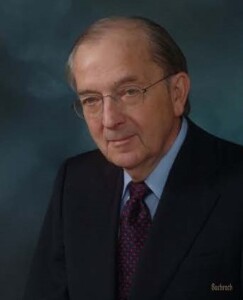
Dr. Donald Korb is a renowned clinician, clinical scientist, researcher, and inventor. He received his Doctor of Optometry degree from the New England College of Optometry followed by graduate studies at Boston University and Boston College.
Early in his career, his exposure to contact fitting and their limitations began a long journey in identifying and naming contact lens complications, determining their causes and finding resolutions.
His first major project was the development of the CSI lens, a novel optical membrane, which improved oxygen supply to the cornea and became the forerunner of the contemporary contact lens. Its success led to a continuing flow of new concepts, rooted in research, which translated to improvements in clinical practice, decreasing complications and increasing patient comfort.
He discovered and named eight conditions related to the anterior segment of the eye, most important of which is Meibomian Gland Dysfunction, acknowledged today to be the leading global cause of dry eye. Other conditions which remain of contemporary significance are Giant Papillary Conjunctivitis, Lid Wiper Epitheliopathy, and Lid Seal.
Once the conditions were identified, along with colleagues, he addressed treatments, resulting in two major dry eye drops, Soothe XP and Systane Balance, and instrumentation for diagnosis and treatment, Lipiview and LipiFlow, the first FDA approved dry eye treatment.
Dr. Korb’s 110 scientific articles, new instrumentation and numerous treatment regimens have impacted the care of over 50 million contact lens patients and tens of millions of dry eye patients.
Video presented at ASCO’s Annual Business Meeting
2022 Recipient
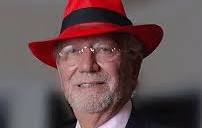
Dr. Herbert Wertheim is ASCO’s inaugural Herbert Wertheim Award recipient. Dr. Wertheim received his award in October during a special recognition reception in San Diego during the American Academy of Optometry’s annual conference.
Dr. Herbert A. Wertheim is a Doctor of Optometry, inventor, businessman and philanthropist. Dr. Wertheim is also the founder and president of Brain Power Incorporated and in 1969 invented an eyeglass tint for plastic lenses that would filter out and absorb dangerous UV rays.
Wertheim serves as the Founding Chairman of the FIU Herbert Wertheim College of Medicine, as advisor to The Nicole Wertheim College of Nursing and Health Sciences at Florida International University, and as honorary chairman of The Herbert Wertheim College of Engineering at the University of Florida.
In 2021, Dr. Wertheim donated $50 million to UC Berkeley Optometry, now known as the Herbert Wertheim School of Optometry & Vision Science at UC Berkeley.
More information on Dr. Wertheim can we found in this profile published in Forbes.