Eye on Optometry

Posted by: Katie Rachon, Indiana University School of Optometry

Take a moment to reflect on the accomplishments you plan to achieve as a Doctor of Optometry. Maybe your hopes and dreams mirror those of a family member who is a Doctor of Optometry or maybe they are the result of a relationship you have with a mentor who is in the optometric field. Possibly your goals are simply ones that you have imagined yourself. Now envision that upon graduation, you are not allowed to prescribe the drugs you used to treat patients in your clinical rotations, or that your ability to performexceptional refractions is undermined due to the popularity of a phone app. How do you give the best health and eye care to your patients? Often our ability to see the past as well as the future is blurred. It seems unfathomable to imagine the profession of Optometry 50 years ago and even harder to envision what it might become. The great strides made in the field of optometry are, in part, thanks to the American Optometric Association (AOA), which has fought for, and continues to fight for optometrists’ rights to provide the highest standard of care for our patients as well as ASCO, which is committed to achieving excellence in optometric education and to helping its member schools, including my own, prepare well-qualified graduates for entrance into the field.

Why should I become a member of the AOSA?

Student Freebies

When you join, the AOSA will send you useful and fun items each year, such as baseball caps, pins, clipboards, binocular vision and contact lens kits, business cards, and much more! You will also receive a copy of the AOSA magazine, Foresight, and the AOA magazine Focus to keep you up to date with student activities and opportunities. In addition, you will be informed on how the AOA is fighting for your optometric future. Members can earn travel grants to Optometry’s Meeting and Academy, as well as scholarships. AOSA members have the most student resources available to them, which will give them advantages upon graduation when they become doctors and full AOA members.

Leadership and networking opportunities

Being in optometry school already shows initiative and hard work beyond that of an average student. Becoming the best Doctor of Optometry you can be requires more than just studying hard. It requires interaction with your peers and broader experiences. By becoming involved in AOSA, you have the opportunity to plan events, represent your school nationally, write journal articles, and participate in ASCO-sponsored podcasts and blog posts. The networking opportunities are plentiful and you have the ability to meet students and faculty from other institutions, doctors currently in practice, and many leaders in the optometric community.

Being part of something bigger

The AOSA is the student partner of the AOA, and by association, your participation and support is a critical part of maintaining and promoting the standards of optometric care. We are the next generation that will be responsible for the nation’s eye health, and who doesn’t want to be the best they can be? By being a participating member, not only can you be sure that your dues and efforts are going to a good cause, but your participation provides many benefits.

How can I join the AOSA?

The AOSA accepts applications from all optometry students at every level, and is also open to undergraduate students who are interested in optometry and completing pre-optometry coursework. Joining is a simple, and you can begin to benefits the benefits of membership right away.

Pre-Optometry Membership

If you are a pre-optometry student, you are also encouraged to join! Pre-optometry clubs have the opportunity to receive membership money back if more than 25 members of their club become members. It is easy to join online at www.theaosa.org.

Fill out a paper application with your school’s AOSA Trustee

Keep an eye out for AOSA events happening at your school near the beginning of the school year; attending an event is a great way to learn about each school’s benefits and fill out a paper application. Some institutions even offer a one-time payment for all four years, which conveniently provides you with membership without having to worry about repeatedly paying.

Fill out an online application

If you aren’t able to attend an AOSA event, an application can be completed online. Visit the AOSA’s website and you’ll find the link to the application under the “Membership in the AOSA/AOA” tab.

Automatic Enrollment

If your school doesn’t offer applications, it may be that you attend an institution with automatic enrollment. Either paid for by the school, or included in your tuition, you are automatically a member for all four years!

Am I already a member and have I already paid for the current year?

To find out if you are a member of the AOSA, contact your school’s AOSA Trustee. To determine who that may be, go to theaosa.org and under the “About” header, click the “16-17 AOSA Board of Trustees” tab and scroll until you find the representative from your school. He or she will be more than happy to help you and will also be eager to answer all the questions you may have.

How can I become more involved once I join?

Being a member not only shows your commitment to the profession and your fellow students, but membership also offers many amazing opportunities to have fun with your classmates, build your leadership skills and network with doctors in your state and across the country.

Attending your school’s local events

Giving yourself time to relax amongst the mountain of schoolwork is very important to making optometry school fun and memorable. Many institutions’ AOSA chapters host events, parties, and dances (can you say prom repeat?), or work closely with the local student government chapter. An event ticket with an AOSA membership may even cost you significantly less than a ticket for a non-member!

State Association Meeting

Being involved with the AOA chapter in your state or your school’s state has many networking benefits for students. Many state associations meet once or twice a year, and welcome students to come interact with doctors and faculty, as well as listen to presentations and award ceremonies. To see how your state is active in the AOA community, visit theaosa.org and under the “Membership in the AOSA/AOA” tab, click on “Know your state optometric association” for a list of contacts and websites.

Optometry’s Meeting

At Optometry’s Meeting, doctors from all over the nation gather once a year to reconnect, network, listen to lectures and continuing education, and vote in the House of Delegates. As a student, there are several networking opportunities, such as the exhibit hall where you can talk to vendors such as equipment companies and pharmaceutical reps, an alumni reception for your school, and a residency meet and greet where you can learn about all the residencies available. At Hoya’s Trivia challenge, you can network with students from other schools to win amazing prizes. The biggest student event is the Varilux Optometry Student Bowl, where a student from each school uses their optometry knowledge to win bragging rights for his or her school! During this event, you enjoy some friendly competition and team spirit.

Will it really matter if I don’t join?

We’re all feeling Olympic fever so, imagine that you are Usain Bolt. You’re so good at what you do that you don’t need any insurance, because you’ll never have a problem running. The next week during training you have a bad fall, subsequently injuring your leg. What do you do now? You didn’t get insurance because you thought this would never happen to you. Now in an instant, your career is over.

This is a common analogy in optometry that the AOSA/AOA is your insurance. You may think that by not joining it won’t make a difference, but if everyone thinks that way, we as the next generation of optometrists will have no protection of our profession. By joining, not only are you supporting your classmates and your professors, you are ensuring that the optometry dreams you recalled at the beginning of this article have a chance of coming true. Our profession is a great and rewarding one.  It is up to us to keep it that way!

Go to news article page

Anyone familiar with the optometry school admissions process would say it’s more like a marathon than a sprint. One of the mileposts, by the way, is actually submitting the application to one or more schools through the online Optometry Centralized Application Service (OptomCAS), which opened for the 2016-2017 cycle on June 29. But there’s more to the process. Dr. Mark Colip, who is currently Vice President for Student, Alumni & College Development at Illinois College of Optometry, chaired the college’s Admissions Committee for 23 years. During that time, he reviewed more than 25,000 student applications. He recently told Eye on Optometry, “The application process is designed to help you best prepare for matriculation and success in optometry school as well as to prove yourself worthy of the seat.” Dr. Colip recommends that instead of taking a “what do I have to do to get admitted?” approach, students should ask themselves “how do I best prepare myself for success in the application process and at the schools to which I’m applying?”

Dr. Colip shared the following five tips for applying to optometry school. Tips six through 10 were provided Jessica Blank, Associate Director of Admissions at MCPHS University School of Optometry. Tips 11 through 15 were provided by Dr. Maryke Neiberg, Associate Dean for Academic Affairs at the Chicago College of Optometry at Midwestern University.

1  Apply early. Never wait until application deadlines are approaching.

2  Proofread your application. Everything counts, including spelling and grammar.

3  Truthfully represent yourself. Honesty is best regarding all aspects of your application, including the weaker areas.

4  Visit campus(es). Contact the schools you’re interested in early and try to visit each one. They’re all interested in helping you succeed with your application.

5  Realize that application to optometry school starts long before you begin filling out the onlineOptomCAS application. Always strive to do your best and prepare yourself the best you can for applying, but also for the rigors you’ll face once admitted and starting optometry school.

6  Create a timeline. Develop a timeline for your application process – and stick to it! Don’t wait until the last minute to apply. On your timeline, identify schools that have rolling admissions. Those schools review applications as they come in and notify students as soon as they’re accepted rather than on one set date. Throughout the entire admissions process, be sure to rely on the admissions office as a source of guidance.

7  Understand the requirements. Create a spreadsheet or “cheat sheet” that includes all of the requirements for the Doctor of Optometry programs you’re considering. Make a note if a program allows you to apply in-progress courses to prerequisite requirements, or if it allows you to complete some prerequisites after you’re accepted.

8  Study smart. Think about your study schedule for the Optometry Admission Test (OAT) ahead of time. Ideally, you study for the OAT at a time when the course material is fresh in your mind, but you don’t want your OAT study time to overlap with your mid-term or final exams. Plan for study time when you can solely focus on the OAT, so that you can set yourself up for success.

9  Gain critical exposure. Though it’s not necessarily a requirement for application, gaining exposure to the optometric field can strengthen your application. By shadowing an optometrist, or several, you’ll gain important insight into the field, which will be beneficial if you’re granted an admission interview. And, there’s no better way to discover whether the optometry field is right for you than by experiencing it first-hand.

10  Ask questions. This is an exciting time of exploration and discovery, and the best way to gather information is to ask plenty of questions. To prepare for your interview, write a list of questions ahead of time. Be sure to ask your interviewer if you can connect with a current student who can share his or her perspective on the program. Also take the time to ask questions of the optometrists you shadow. The more information you have at your fingertips, the better prepared you’ll be as you take the next step toward an exciting future in optometry.

11   Follow up. Work with admissions to guide your application through the process. They have a wealth of experience and their dedicated team will help you every step of the way.

12   Consider your OAT scores. If you think you probably should retake the OAT, study hard and retake it as soon as possible so you have the best possible scores to represent your abilities.

13   Plan and leave enough time. Take the time to plan each step of your application. A potential challenge, for example, could be to have your letters of recommendation submitted on time. Have a backup plan and allow time for unexpected delays. Plan to be sure you meet all the prerequisite coursework requirements.

14   Present your professional self. Once you’re invited to a school to interview, you’ve made it through the most competitive part of the application process. Present the best you by dressing professionally, and be prepared to ask questions about the school or college. Put your mobile device away, make eye contact, and be in the moment.

15   Decide which school is best for you. Make sure the schools or colleges of optometry you apply to are a good fit for you. Start by studying their websites. There you’ll find the most important and up-to-date information. Some things that may be important to your decision could be class size, licensing pass rates, research opportunities and community service activities. In addition, many of the schools have areas of concentration or features that make them unique. Consider your interests and strengths when looking for a match. Make sure that you would generally fit in well and feel welcome. Talk to current students about the culture and extracurricular activities.

Go to news article page

Posted by: Dr. Andrew Buzzelli

A group of very talented professionals opened computers on a warm, sunny mountain morning and began the longest educational journey of their young lives. Well beyond the stage of their student lives they have earned a position as adult learners in the premier health care profession. This will be repeated 21additional times over the next weeks as our Optometry College Colleagues across the country come on line for a new semester.

Everyone, faculty, administrators, staff and upper class turn their focus toward these vision care providers of the future. This year’s first year classes represent a much different calling than the years that have gone before them.

Here at The University of Pikeville, Kentucky College of Optometry this new assembly of men and women faces a new program, in a new building, with a new mission. The new mission is born in a place of unmatched and untouched natural beauty. A place where the blindness and poverty of Central Appalachia stands as a formidable foe for these young warriors.

The students in the other Schools and Colleges are equally challenged. Challenged to change the scope of practice for the profession nationally. We now have three states where primary care surgical procedures are the venue of Optometric care. The first classes of Optometry Students in all schools this year herald a new standard in Optometric Education. They will forge the new scope of Optometric practice in all of our states in the decades to come.

Our school has been labeled the Vision of Hope by our local media. This salutation can be applied to every 1st year student in this dawn of a new optometry.

Go to news article page

According to admissions officials at several of the schools and colleges of optometry, parents of prospective students often have similar questions about the admissions process and optometry school in general. Their questions tend to center around the costs of tuition and housing, availability of financial aid and the safety of the area where their sons or daughters may be living for four years of their lives. When Hannah E. Barker expressed an interest in becoming a Doctor of Optometry, she and her dad, David J. Barker, an attorney in Carmel, Ind., wanted to explore additional matters such as the schools’ job placement rates and the median salary for a first-year optometry school graduate. Hannah narrowed the list of schools she wanted to apply to, and, her father says, “Two optometry schools immediately came to the forefront with answers and information that convinced not only my daughter but our family that the optometry profession is a leading career that allows a practicing optometrist to not only enjoy a rewarding occupation but provides a foundation for the ability to raise a family, be involved in a community, and give back to our society in general.” Hannah was accepted by the University of Pikeville Kentucky College of Optometry and Indiana University School of Optometry (IUSO). She’ll start classes at IUSO in fall 2016.

The Appropriate Role for Parents of Students Applying to Optometry School

All of the schools and colleges of optometry want their applicants to make informed decisions about whether to pursue an optometric career and which school is best for them. And they know students don’t always make the decisions without input from others, such as parents or mentors. Therefore, parents and other guests are welcome at some of the various admissions-related events that take place. For example, most schools have the equivalent of an “Admission Day” where parents or other guests can accompany prospective students for campus tours, information sessions and opportunities to speak directly with faculty, current students and alumni.

At the University of Missouri at St. Louis College of Optometry, explains Director of Student and Alumni Services Nicholas Palisch, parents and guests can be part of an interview day information session and interact with admissions officials during the tour, during lunch and while they wait for the applying student to complete his or her interview. Other than that, Palisch says, “While we welcome questions from parents, we would like them to come from the student as they are the primary point of communication.” Cindy Vance and Joe Boes, Director of Student Admission and Associate Director of Recruitment and Student Services, respectively, at Indiana University School of Optometry, agree. Notes Vance, “Parents are welcome to be part of the student’s Admission Day experience, and they frequently attend open houses and visits prior to the student applying. We also enjoy reconnecting with parents of matriculated students at our White Coat Ceremony and then again at graduation. But other communication, such as by e-mail and phone, is primarily with the student only. Professional students are considered independent.”

When parents call the University of California-Berkeley School of Optometry with questions, they’re directed to the school’s website where most of the answers can be found and told they’re welcome to attend a campus tour and/or the Admit Day social. “But we ask that they have the applicant call us,” explains Sharon Joyce, Assistant Dean for Admissions, Student Affairs, and Career Services. Joyce says the school wants to know that a student is applying on his or her own volition. She offers this advice, “Different schools have different philosophies about the involvement parents should have at the graduate level. Some schools actively encourage it. But to make sure you’re putting your best foot forward, you may want to consult with each school you’re interested in about its own philosophy.”

Useful Questions to Ask about Optometry School

As previously mentioned, parents of optometry school hopefuls tend to have similar questions. In addition to parents and students wanting to know the costs of tuition and housing, availability of financial aid and campus safety, admissions officials say they commonly field questions about their programs’ average
NBEO (National Board of Examiners in Optometry) scores, employment statistics, average student loan debt, students’ accessibility to faculty members, strengths of the program, and types of students who make up the student body (e.g., age and gender).

With all of his family’s questions about optometry school answered, Mr. Barker says, “I am extremely proud of my daughter’s decision to attend optometry school. It makes me happy that optometry schools seem to attract and groom leaders in our society.”

Go to news article page

If you’re thinking about becoming an optometrist, chances are you also lean toward the entrepreneurial side of life. Lots of optometrists do. According to a survey by the American Optometric Association, 53% of ODs are practice owners.1 Eye on Optometry caught up with three recent optometry school graduates who started their own practices, and are very glad they did.

The reasons these three optometry school grads wanted to own their own practices are similar. They want to be in charge of how they practice; they want to create the practice culture; and they want to be the ones making the important business decisions that will affect their lives and the lives of their patients. “First and foremost, we want to build a practice that embodies the type of care we want to provide,” says Valerie Lam, OD, FAAO. After graduating from Southern California College of Optometry at Marshall B. Ketchum University in 2012 and completing a residency in Pediatrics and Vision Therapy, Dr. Lam and aformer classmate, Thanh Mai, OD, opened Insight Vision Center Optometry in Costa Mesa, Calif., in May 2015. They chose to focus the practice on vision therapy and orthokeratology. “By focusing our efforts, we can become great in those areas and really make our practice stand out,” she says. “We had worked at other offices that do things well, but perhaps not exactly the way we would do them ourselves. For example, if we want to make sure that a patient is 100% satisfied with his or her glasses, we can have an ‘until satisfaction guaranteed’ return policy, whereas another practice may limit returns. If we believe in putting the patient first in all we do, then bending over backwards for the patient will ultimately pay off in the long run.”

Dr. Lam and Dr. Mai wanted the practice to be self-sustaining financially, so they applied for and received a small business loan, which got them up and running until the business started generating money on its own. “People think you have to have a lot of money sitting in your personal bank account to start or buy your own practice, but I learned from this experience that it’s not as hard as you think,” Dr. Lam says.“Getting a bank loan was actually rather easy.” She and Dr. Mai also had their families in mind when they decided to go forward with their plans to open a practice. “With a 2-month-old baby at home, owning my own practice allows me to have control over my schedule and to be there for my family when I need to be,” she says. “It allows me to juggle my responsibilities as mom, wife and doctor.”  Currently, Insight Vision Center Optometry has one location and three employees, all of whom are aspiring to become optometrists.

Shaping Their Own Optometric Careers

Rosalyn Coleman, OD, a 2010 graduate of Southern College of Optometry who completed a residency in Pediatrics and Binocular Vision, also opened her own practice cold, i.e., from scratch. She opened her doors at Envision Therapy in Woodstock, Ga., in 2014. Like Drs. Lam and Mai, she chose a focus. After her residency, she worked in numerous types of practices, but as she describes, “However, I always knew that I eventually wanted to have my own specialty vision therapy practice. When I first started out, I thought I wanted to have a primary care office that included vision therapy, but I quickly realized two things. I didn’t want to be involved with insurance plans, and I needed to offer something that made me unique, something that separated me from the hundreds (or thousands) of other optometrists in the Metro Atlanta area. So I let the idea of primary care go before choosing a location and decided to focus solely on vision therapy and specialty, private-pay care.” Since her start, Dr. Coleman has added orthokeratology and specialty contact lens fits to the practice. “Two more ways to provide top-notch, customized care to my patients in an environment where they don’t feel rushed and don’t have to wait long to be seen,” she says. “I love having this type of flexibility to change, re-imagine, or add aspects to my practice so that I stay happy as well.”

Dr. Coleman took out a bank loan to get started. The funds enabled her to purchase equipment. She notes that one benefit of having a specialty practice is needing less funds compared with a primary care practice. “I don’t have an optical or need a lot of staff to operate efficiently, so my overhead is fairly low. And, fortunately, the location I chose allowed me to have 14 months of free rent, which helped with having extra funds for marketing, etc.” Because she doesn’t accept insurance, Dr. Coleman spends significant time attending networking events and introducing herself to other professionals and doctors in order to get the word out about the services she offers. The practice has one location and one staff person, who sees the majority of the vision therapy patients while Dr. Coleman carries out evaluations and consultations and goes to networking events. “Because I don’t accept insurance, we’re able to maintain the office really well without any extra help,” she says. “Eventually, as we grow, I’ll add staff.”

Wyatt Williams, OD, launched his own practice, Keys Eye Care in Park Hill, Okla., shortly after graduating from Northeastern State University Oklahoma College of Optometry in 2015. He purchased a small existing practice and also the equipment and records from a practice that had closed. “Both previous owners are carrying the note, so financing was not much of an issue,” he says. “I took out a small loan for operating expenses and do a little bit of fill-in work to supplement my income.” Dr. Williams currently offers full-scope optometric care, referring patients out when necessary for imaging with equipment he doesn’t yet have. He plans to buy one piece of equipment at a time until he has everything he needs to manage any ocular disease. “I haven’t focused in any one area yet,” he says. “I’m still getting a feel for my interests and what services are most in demand in my location.” Dry eye and low vision are areas Dr. Williams says he may want to expand.

Originally, Dr. Williams was working out of two locations. He stayed open at the existing practice he bought and re-opened the one that had closed. After several months, he decided to combine into one office, the busier of the two. He currently has three employees: one person who covers the front desk and handles orders and billing and two technicians/scribes. “Everyone is cross-trained to fill in at any position if needed,” he says.

So Far, So Good

Dr. Williams says being a practice owner was stressful at first, but he enjoys seeing all of his work coming together and getting feedback from patients. “There are lots of decisions to be made upfront that can affect the future of the practice significantly,” he says. “But it’s nice to be able to make changes to improve patient care and increase efficiency and see the improvement immediately.” Dr. Coleman, too, is seeing all of the effort and hard work she put in at the beginning of her venture starting to pay off. As she describes it, “Owning a practice has been the most awesome, challenging, gratifying and terrifying experience ever.”

While giving their all to making their new practices a success, Drs. Coleman, Williams and Lam also keep their long-term goals in sight. Dr. Coleman would like to open another office in another part of the metro area where there’s a need for specialty care. Dr. Williams would like to build a larger building, fully equip it with state-of-the-art technology and hire an associate. And Dr. Lam looks forward to “building our network of referral sources so that people know what we do and know that we do it the best in town.”

Reference

  1. 2014 AOA Survey of Optometric Practice. Practicing Optometrists and their Patients [Internet]. St. Louis, MO: American Optometric Association; c2015 [cited 2016 May 19]. Available from: http://www.aoa.org/optometrists/tools-and-resources/research-and-information-center/survey-reports/survey-of-optometric-practice?sso=y.

Go to news article page

Posted by: Dr. Arol Augsburger

The first recollection I have of interacting with ASCO Board members goes back to the early 1970’s when I was a young and naïve faculty member of The Ohio State University (OSU). Dr. Frederick Hebbard at that time was Dean of the OSU College of Optometry. He had followed Dr. Glenn Fry who was the Director of the optometry program before it gained independent college status. Dr. Hebbard had arranged for a meeting at the then new Fawcett Center on the OSU campus and had invited ASCO representatives to attend. I remember meeting Dr. Meredith Morgan, Dr. Henry “Hank” Peters, Dr. Bill Baldwin, Dr. Norman Wallis, Dr. Wid Bleything, and Dr. Henry Hofstetter among many other attendees representing the schools and colleges of optometry existing at that time… half the number of institutions we have today. These “guys” could talk, and talk, and talk. They were brilliant but highly opinionated leaders and I felt privileged to meet them.

Later, in the 1980’s it was my honor to accompany Dr. Richard Hill, then the OSU Dean, to the ASCO meetings and sit in the back chairs. While the number of institutions had grown to 17 by that time, the Directors, still all “guys,” easily fit around a single large table. During that time there was an initiative to involve more institutional people in ASCO committees and that had benefits both for ASCO and the participating member institutional participants. The debates between Dr. Norman Haffner and Dr Dick Hopping were memorable parts of our long ASCO meetings at that time.

In the early 1990’s, I attended my first ASCO meeting as the new Dean of the University of Alabama at Birmingham School of Optometry and for the first time was able to sit at the big table. During the 1990’s the concept of SIGs (Special Interest Groups) took hold and many interested institutional faculty and staff participated in broadening the reach and effectiveness of ASCO by sharing best practices. I was privileged to serve as President of ASCO during this decade, but needed to step down from the ASCO Board for two years when I served as Interim Provost of the University of Alabama at Birmingham.

During the 2000’s, I had been appointed the President of the Illinois College of Optometry (ICO), an optometric institution which traces its roots to 1872, before we even referred to what we do as optometry. Indeed, the institution functioned under the name of the Illinois College of Ophthalmology and Otology. ASCO was not founded until 1941 during a time of great stress in schools and colleges of optometry since so many of the prospective students, still mostly male, were serving in World War II and not enrolling in college. Talk about an application crisis!

In my role as President of ICO, I have less involvement in the day to day education and clinical training of our outstanding doctors of optometry (we Presidents are busy raising the institutional flag and raising money). The important work of the welfare of our students, and our educational and patient care programs, has been delegated to our Academic, Student Affairs, and Clinical Deans. I’m pleased to observe that most of my colleague CEOs have also encouraged their Deans to have an even bigger presence in ASCO and this has benefited us all.

I have now finished my forty-fifth year in higher education, and am more enthusiastic, though less naïve, than I was in 1971. It has been a work of love to toil with so many ASCO colleagues over the last five decades to literally change and expand the profession of optometry, and to do it in such a way that the educational underpinnings at our 23 ASCO institutions will support the expanded and publically needed role of optometrists as primary health providers… providing expertise in matters impacting our patients vision, eye health and systemic well-being.

ASCO has been important. ASCO is needed now even more than ever in its 75 years. The contemporary version of ASCO does it by broadening the definition of “guys” to apply to men and women.

Congratulations to you fellow ASCO Board members and Executive Directors for making this work!

Go to news article page

Educational research should be at the forefront for all faculty, independent of subject taught, degree or level of education. Educational research can provide information on how our students learn and how we can be more effective teachers. Best practices for teaching methodology, delivery and assessment arekey to our success in the academic environment. Outcomes assessment along with the dissemination of information (publication) should be a goal for all faculty. How do faculty and administrators make curricular changes in education? Are decisions based on trying something new, trying to be different, and opinions or are changes driven by well-designed educational research? Evidence-based teaching is not a new concept and should drive the decision making in academia. In some circles, educational research has not been considered as important or necessary as basic research or clinical research. This may be secondary to prestige, incentives and funding sources. There is also the misguided notion that expertise in a subject translates to the ability to teach the material. Educational research can help educators be successful. Additionally, it can have a major impact in the professions of optometry and academia.

ASCO is pleased to support educational research by offering Educational Starter Grants. The Educational Starter Grants support short term projects that help faculty get involved with educational research. This is a great way to learn more about your student’s learning and your teaching. Several grants have been awarded since 2011. I encourage all faculty to consider applying for an Educational Starter Grant this year.

Go to news article page

Eye on Optometry recently asked students and graduates to tell us what they consider to be the Best Things about Optometry School. And while the answers convey a lot about optometry school, they say just as much about the students and graduates themselves. For starters, their enthusiasm for all things optometry school — and optometry in general — is obvious.

First-year students tend to be very happy about the small class sizes they encounter at optometry school. As one of them notes, “I get to actually know people!” The whole atmosphere is invigorating, they say, “seeing how motivated everyone is and how hard everyone works and helps each other, all because we have the same ultimate goals.” They find it quite nice, too, “how everyone there finally understands your obsession with eyeballs.”

Speaking of getting to know classmates, one first-year student describes optometry school as an “inclusive community.” A third-year student puts it like this: “I had always heard that optometry is more like a family than a profession, but I just didn’t understand how that could happen. But after being here at school for only a few short weeks, I quickly saw my class turn from individual students into one big family. We are all so very supportive of each other not only in the classroom but in the clinic and also outside of school.” All through school, one 2015 graduate says, he liked “learning in a community setting where the entire class is rooting for me to pass my exams and proficiencies.” Graduates in particular use the word “lifelong” to describe their optometry school friends.

Being totally engaged in their education and preparing for their career is a common attribute of optometry students regardless of what year they are. Every top list mentions some sort of relevant activity, including extracurriculars. Some examples: the opportunity to be part of many optometry organizations; traveling to other cities for conferences; making a difference through volunteering, political activism and social networking; “being involved in AOSA and establishing my roots in organized optometry.” As one first-year student sees it, “If you’re bored in optometry school, you’re doing it wrong.”

Optometry students’ and grads’ Best Things lists also show they genuinely enjoy what they do in optometry school and appreciate its value in preparing them for their careers. Even studying makes a few lists! From a third-year student: “Studying becomes much more fun in optometry school because it is all things that are interesting to you and something that you will actually be able to apply in clinic.” The lists reveal a love of learning optometry as well, with the Bests including learning about ocular diseases; fitting contact lenses; learning how to use the phoropter; “practicing techniques and watching how much you improve over the year”; learning something new about the eye every day; and finding the optic nerve for the first time. And when it’s time to work with patients in clinic, “completing the first full eye exam is one of the best feelings in the world.” Also a thrill: “Giving your patient their first pair of glasses/contact lenses and seeing their reaction.”

Faculty are a fixture on the lists, from first-year students’ to graduates’. A graduate recalls “supportive faculty who devote all their energy towards making me a better doctor,” and a first-year student remembers realizing that “your professors are world renowned experts in their field.” A third-year student’s list includes “Faculty that are dedicated to helping you succeed.”

But there’s more to optometry school than, well, optometry school. A third-year student notes how he likes having “schedules that are busy but still allow time to have fun outside of school.” Formal and semi-formal “Eye Balls” that take place at many of the schools and colleges of optometry are a student favorite. Students also take advantage of the scene around them. You may guess where one graduate learned to perform a comprehensive eye exam in Spanish and took “study breaks on the beach,” (Puerto Rico), and, while it could be a lot of places, where a first-year student raves about “the food in the area!” (Berkeley, Calif.) Also appearing among the Best lists are the perks that come with optometry school, such as discounted or free eyecare publications; “being able to try every brand of contact lens so we can speak about them from experience”; attending national conferences at a discounted rate; and “being able to answer all the questions your family and friends have about their eyes.”

If we had to pick a sentiment that shined through from the stack of Best Things about Optometry School lists we received, it would be, as one student writes, “becoming someone who will make a difference in people’s lives.” And this list item from a first-year student kind of sums it all up: “I love optometry school because we’re all working our hardest to become doctors who will one day be able to really help people to see. The long hours, the hard exams, the gallons of caffeine will all be worth it, and in the meantime we’re all in this together.”

Eye on Optometry thanks the students and graduates who sent us their lists of Best Things about Optometry School: Keylee Clemons Brown, OD, 2015 graduate, Inter American University of Puerto Rico School of OptometryElizabeth Brubaker, third year, The Ohio State University College of Optometry; Mina Choi, first year, University of California – Berkeley School of Optometry; Amanda Himmel, first year, Michigan College of Optometry at Ferris State University; Emily Krueger, second year, Michigan College of Optometry at Ferris State University; Aaron Tai, third year, Illinois College of Optometry; Lawrence Yu, OD, 2015 graduate of Southern California College of Optometry at Marshall B. Ketchum University; and Ashley Zinser, fourth year, Northeastern State University Oklahoma College of Optometry.

Go to news article page

One of the many appealing elements of a career in optometry is the variety of settings in which doctors of optometry can work. We asked ODs from several different practice types to answer some questions, including what they find most challenging and most rewarding about their job, to give you a glimpse into the possibilities. Part II of this blog will cover the following settings:  large group private optometry practice, private practice (two owners), corporate optical adjacent and the opththalmic industry.


LARGE GROUP PRIVATE OPTOMETRY PRACTICE

Antonio Chirumbolo, OD

(State University of New York College of Optometry, Class of 2013)

Employed with Complete Family Vision Care, an eight-OD, multi-location group private practice in the Pittsburgh area

What does your practice setting have in common with other practice settings?

The setting in which you practice can differ dramatically, but that doesn’t necessarily have to dictate how you practice. Although I practice in a large group setting, I perform many of the same daily tasks as eyecare providers in other practice modalities.

In what ways does your practice setting differ from others?

Practicing in a large group setting can give you access to a very large patient base, which means that you have ample opportunity to see a diverse population of patients with different eye disease and conditions. It can also afford you the opportunity to practice to your full scope. It’s not uncommon for each doctor to have different strengths within the practice, from pediatrics to specialty contact lens fitting. This allows us to keep a lot of patients in-house rather than refer them out.

How is the bulk of your average work day spent?

The bulk of the day is spent seeing patients and billing and coding. Very little of my day is spent on practice management because we have dedicated staff and a dedicated owner handling the business aspect of the group.

What other tasks/roles are included in your work day?

I’m always working on ways to build the practice. Whether it’s scheduling local school screenings or developing various marketing materials such as newsletters and advertisements, there is always something to be done when I’m not seeing patients. Brainstorming and working with staff to develop practice-building opportunities is something we routinely work on.

What do you consider the biggest challenge of working in this setting?

Working in such a large practice and seeing so many patients can become overwhelming at times. It’s not uncommon for me to see more than 30 patients a day, and many of the cases are complex and involve special testing. Because we see a lot of pathology at our practice, it can be heartbreaking telling a patient they are suffering from a sight-threatening condition, or have suffered irrevocable damage to vision, which may or may not return.

What do you consider most rewarding about working in this setting?

A majority of the patients I see have been coming to see us for their eyecare needs for decades. Seeing the same patient year after year is very rewarding as you build intimate relationships with them and develop a strong rapport. These patients become extended family members. It’s also a great feeling to have a group of experienced doctors working with you. As a new(er) graduate, it’s not uncommon to run into cases or conditions that you might not be sure how to handle or manage. It’s always a good feeling when you can get the opinion of experienced doctors!

What is your work schedule?

I work six days a week, Monday through Saturday. However, we are only open every other Saturday from 8 a.m. to noon. Tuesday through Friday we work 9 a.m. to 5 p.m. Mondays we work from 9 a.m. to 8 p.m.

What aspect(s) of your practice setting might other doctors not like?

It can be difficult to build your practice within the practice, so to speak. That’s why it’s important to involve yourself in the community and get to know people. That takes a lot of hard work and energy and often takes time outside of the usual working hours. In other words, it involves a lot more than just seeing patients to be successful in this practice modality.

What advice would you give about choosing a practice setting?

Envision the type of days you want to have. If your goal is to punch a clock and check out at 5 p.m. every day, private practice is probably not going to be a good setting for you. It’s not uncommon for me to work after hours or call patients or pharmacies on the weekends. If you want to be part of something, and immerse yourself into building a practice, and stay somewhere long-term, then private practice is a great avenue. It’s also a great way to be your own boss in the sense that you have authority over what type of culture and experience for patients you want your practice to reflect.

PRIVATE PRACTICE, TWO OWNERS

Thanh Mai, OD

(Southern California College of Optometry at Marshall B. Ketchum University, class of 2012)

Co-owner of Insight Vision Center, Costa Mesa, Calif.

What does your practice setting have in common with other practice settings?

Every individual has different strengths, weaknesses, and a unique approach to patient care. Having a partnership allows for multiple viewpoints and more creativity in terms of offering the widest range of services to patients and in terms of building a practice.

In what ways does your practice setting differ from others?

We focus on vision therapy and specialty contact lenses. Because of this most of our patients are children, some very young, who we’re treating for conditions such as double vision or progressive myopia. Having a partner in practice to immediately consult with and bounce ideas off is a great benefit in treating patients with very challenging visual problems.

How is the bulk of your average work day spent?

Some days are devoted mainly to patient care. Some days we purposely see fewer patients in order to devote time to managing the practice.

What do you consider the biggest challenge of working in this setting?

We have a relatively new office so our biggest challenge is creating awareness of our unique services to potential patients in our area.

What do you consider most rewarding about working in this setting?

The ability to create a culture that really appreciates patients and treats them as close friends and family.

What is it like working with children compared to with adults?

I could write books about this! Children are such a mixed bag and each one has such a different personality that evolves in the short amount of time you see them. One aspect I like about working with children is being able to create a change that can positively affect them for the rest of their lives. It’s quite exciting.

What advice would you give about choosing a practice setting?

Don’t just look for a job. Begin your career thinking about why you wanted to become an optometrist in the first place. Practice in the area you want to live, where you find the most happiness and fulfillment vs. choosing your location based only on your career opportunities.

CORPORATE OPTICAL ADJACENT

Nikil Patel, OD

(Indiana University School of Optometry, class of 2004)

Owner of practice (Vani Vision) leasing space from Costco in Atlanta, Ga.

What does your practice setting have in common with other practice settings?

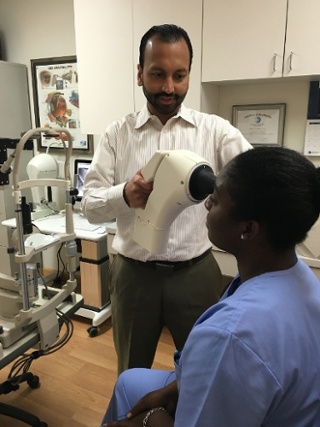
The eye exam area is similar to other practice settings. We have two fully equipped exam lanes, including digital refraction systems. We have a pre-test area that includes an autorefractor, non-contact tonometer, wide-field retinal imaging, and a corneal topographer. (I own some of the equipment, and Costco provides some equipment.) Like other practice settings, we have many diagnostic contact lenses.

In what ways does your practice setting differ from others?

The main difference is we don’t have a dispensary and thus don’t sell contact lenses or eyeglasses. (Costco does.) I’m able to concentrate my efforts only on optometry and not on retail and merchandising, which are different skills.

How is the bulk of your average work day spent?

The bulk of my day is examining patients. I have a very large medical practice that continues to grow and takes the majority of my schedule.

What other tasks/roles are included in your work day?

I have managerial tasks such as paying bills, overlooking financials, managing two employees. I also keep up with the industry and constantly read about all aspects of optometry.

What do you consider the biggest challenge of working in this setting?

The biggest challenge is not having control of the actual building and thus not being able to set my own hours. I can only be open when Costco is open. It’s likely similar to other offices where a landlord or a partnership is involved. Both parties need to be considered.

What do you consider most rewarding about working in this setting?

Most rewarding about this setting is that patients appreciate that there is no financial bias in my recommendations for eyeglasses or contact lenses. I’m not selling them anything, and I believe because of that they tend to adhere to my recommendations.

What is your work schedule?

I work Monday through Thursday 10 a.m. to 6 p.m., and Fridays 10 a.m. to 5 p.m., with a one-hour lunch each day. I’m off Saturday and Sunday.

What aspect(s) of your practice setting might other doctors not like?

Most optometrists make the largest portion of their revenue on eyeglasses or contact lens sales. Working in a corporate-affiliated environment means your practice revenue is solely derived from the patient care interaction, so embracing a medical practice is almost a necessity to grow.

What advice would you give about choosing a practice setting?

Be open-minded and try out different settings. The best way to see which modality is best for you is to work in each for a period of time. Coming out of school, there are many opportunities for hours within different practices, which can be a great guide for your long-term career.

OPHTHALMIC INDUSTRY

Mohinder Merchea, OD, PhD, MBA

(The Ohio State University College of Optometry, class of 1997)

Employed by Alcon in Fort Worth, Texas, as Head of Medical Affairs for Vision Care in the U.S. and Canada

What are the key characteristics of your practice/employment setting?

Medical Affairs at Alcon provides scientific support for late-stage product development and post-market support for medical devices and drugs in the form of clinical trials, medical publications, training and education. Medical Affairs is located within the Alcon corporate headquarters along with other business functions such as Research & Development, Legal, Regulatory and Commercial.

In what ways does your setting differ from others?

A Medical Affairs role in industry doesn’t typically involve direct patient care, but we do have clinical facilities to provide demonstrations or training to eyecare practitioners on the products within Alcon’s portfolio in Vision Care and Surgical.

How is the bulk of your average work day spent?

The majority of my day is spent working with people from all areas of the business to ensure that eyecare practitioners understand how Alcon’s products can help patients see, look and feel their best.

What other tasks/roles are included in your work day?

Medical Affairs helps to formulate publications and presentations at scientific meetings and through journal articles. Medical Affairs also provides the scientific input and expertise in the design or review of marketing materials and tools. We communicate with and support external experts and opinion leaders. We also help respond to questions from patients about our company’s products, and serve as disease state experts to answer questions from internal colleagues.

What do you consider the biggest challenge of working in this setting?

I miss the feeling of successfully fitting a post-surgical cornea or late-stage keratoconus patient and seeing their faces light up with joy when they regain the gift of vision. In industry, that satisfaction of helping patients is indirect but no less satisfying when an eyecare practitioner tells you their patient is wearing a contact lens that you helped design.

What do you consider most rewarding about working in this setting?

In Medical Affairs, I get to represent the voice of the eyecare professional and patient within my business. The decisions or recommendations we make related to a medical device or drug have the opportunity to help millions of patients, so it’s amazing to think about that from a public health significance standpoint.

What is your work schedule?

There’s no such thing as a 40-hour work week, but it really comes down to your individual motivation and drive. In my current role, I have responsibility for the United States and Canada, so the majority of my work is during the day. Prior global roles required late-night conference calls working with colleagues from around the world.

What aspect(s) of your practice setting might other doctors not like?

In my role, what I am working on changes day to day, or faster in some cases. If you’re a person who loves routine, industry in general and medical affairs could  be frustrating. If you thrive in dynamically changing environments, if you’re comfortable making decisions efficiently, and you like to learn constantly, medical affairs can offer you a fulfilling career path.

What advice would you give about choosing a practice setting?

Optometrists have a wide variety of career paths they can take in addition to clinical practice. The best advice is talk to your peers and visit the settings you think you’re interested in for a day to see if they excite you.

Go to news article page

One of the many appealing elements of a career in optometry is the variety of settings in which doctors of optometry can work. We asked ODs from several different practice types to answer some questions to give you a glimpse into the possibilities. Part I of this blog will cover the following settings: academic practice, solo private practice, U.S. Department of Veterans Affairs and corporate. Other practice settings will be covered in Part II.

ACADEMIC PRACTICE

Valerie Kattouf, OD, FAAO

(Illinois College of Optometry, class of 1995)

Associate Professor and Chief of the Pediatrics and Binocular Vision Service at Illinois College of Optometry and Clinical Instructor at the University of Chicago

What does your practice setting have in common with other practice settings?

We are very high volume and, just like most practices, we serve patients of all ages. We see routine refractive errors, fit contact lenses, and treat infants, toddlers, school age children, and adults with a range of visual needs. I see a number of adult patients with double vision issues because our practice encompasses binocular vision care.

In what ways does your practice setting differ from others?

The majority of our patient encounters are complex, involving issues such as complex refractive error, pathology, systemic syndromes, amblyopia and strabismus, so we perform less routine care. Also, our patient population is primarily Medicaid. We do accept private insurance plans, but the majority of our population is underserved. We also work with students, teaching while administering patient care, which is a different way of approaching things.

How is the bulk of your average work day spent?

This is a difficult question to answer for the academic setting because of the variety of roles we have. Some days are primarily clinic, while some days are spent working on administrative issues. I spend a good deal of time preparing lectures for classroom teaching as well as giving continuing education courses around the country. It is this constant variety that makes my career challenging and exciting.

What other tasks/roles are included in your work day?

Administrative tasks, continuing education and seminar lecture preparation, classroom teaching, clinical teaching, research activity, medical record completion, and student clinical evaluations.

What do you consider the biggest challenge of working in this setting?

The patient volume, complex care in clinic, and juggling the other responsibilities. Sometimes the days feel too short.

What do you consider most rewarding about working in this setting?

Helping patients who may not always be able to help themselves. I also enjoy when graduates let me know that I helped them to feel more confident in their abilities, which is always my goal when teaching.

How does having children in the patient mix differ from seeing all adults?

There’s never a dull moment. Pediatric care is fun, but you have to be adaptable and willing to vary from the norm. It’s a true honor to be able to guide parents to the proper treatments for their children and help them to understand the impact of the treatments on all aspects of the child’s life.

What is your work schedule?

I work five days per week, Monday through Friday. My hours vary. I suppose my on-campus hours are 40 per week. I do bring a great deal of work home to do at night, particularly things that I don’t want to dominate my time on campus, such as completing lectures, student evaluations, and medical records.

What advice would you give about choosing a practice setting?

If you can never feel like you have a job, but instead that you’re investing in your career, you’ll never feel like you’re working. My workplace environment is an extension of my family. I love being there, I adore my colleagues, and I feel honored to see patients and teach students daily. Find an environment that inspires and challenges you daily where you feel warmth and purpose.

SOLO PRIVATE PRACTICE

David Hite, OD

(Southern College of Optometry, class of 2013)

Owner of North Range Eye Care in Commerce City, Colo.

What does your practice setting have in common with other practice settings?

Routine patient care is virtually the same wherever you practice. The difference may be in who makes decisions about office flow and how much time you spend with patients.

In what ways does your practice setting differ from others?

I started the practice cold, and in less than three years we have all the technology we need to manage the full eyecare spectrum. As a private practice owner, I have full control of my schedule, how I see patients, and the overall patient experience.

How is the bulk of your average work day spent?

Patient care takes up the majority of my time in the office.

What other tasks/roles are included in your work day?

As the owner of a private practice, patient care is not all I do. In addition to patient care, I take care of overseeing the various departments of the practice, doing payroll and accounting, and taking care of small office maintenance items as well. My wife works in the office, too, and our first child, Dawson, came to work with us every day until he was a year and a half old.

What do you consider most rewarding about working in this setting?

There is a different feeling in seeing patients when you are the owner. You care more about their experience and their final outcome. There is more reward when they have a good experience. Having patients refer family or friends becomes a very personal recommendation for you.

What is your work schedule?

We see patients five days a week, but two days a week we don’t see patients in the mornings. That time is either my time off or time to work on administrative tasks. We don’t work weekends or late hours.

What advice would you give about choosing a practice setting?

Wherever you work, you’ll be building someone’s dream. That could be the owner of a private practice if you are an employee, a corporation, or your own personal practice. If you’re working hard, make sure you’re the one benefiting in the end.

U.S. DEPARTMENT OF VETERANS AFFAIRS

Laura Dowd, OD, FAAO

(New England College of Optometry, class of 2009)

Staff Optometrist and Optometry Student Program Coordinator in the VA Maine health system

What does your practice setting have in common with other practice settings?

We see patients with a wide variety of eye conditions. We prescribe glasses, treat eye diseases and co-manage surgical patients like many other practices.

In what ways does your practice setting differ from others?

The VA setting is an adults-only patient population, and the patient base is generally older males. The VA also has a universal electronic medical record that contains each patient’s entire health record and is able to link to other VA hospitals. The VA also has resources that practices may not, such as low vision and blind rehabilitation services. The eye clinic is part of the patient’s whole healthcare team, not just an individual service.

How is the bulk of your average work day spent?

A majority of my day is spent seeing patients or precepting students.

What other tasks/roles are included in your work day?

Most days include a didactic activity or group meeting, such as optometry journal club, interprofessional education, grand rounds or staff meetings. I also have administrative duties, including triaging consults and coordinating student schedules with the education office.

What do you consider the biggest challenge of working in this setting?

The VA is a large organization with many regulations and layers. I have a certain amount of control within the eye clinic but little to no control over IT, HR, contracting, etc.

What do you consider most rewarding about working in this setting?

Taking care of veterans and having ample time to teach.

How does the VA patient population differ from others and how does that affect your job?

The VA population tends to be elderly, and a majority of patients are male. While most practices draw from a small area, my VA encompasses a large geographic area. Significant travel distances and transportation issues, in addition to caring for the elderly patient, require extra consideration to maximize patient care. For example, it may not be practical to have a patient return next week for a visual field test if he lives three hours away and the shuttle van only goes to his region one day a week. This often leads to squeezing in extra testing that day or overbooking my schedule to “piggyback” my appointment onto a day when the patient is already scheduled for a different specialty visit at the VA. It takes a certain amount of strategizing to effectively and appropriately treat the patient in the most efficient manner.

What is your work schedule?

I work 40 hours a week (four 10-hour days with Fridays off). I do not have any nights or weekends at the VA.

What advice would you give about choosing a practice setting?

Optometry students should expose themselves through their training to a variety of practice modes. When they’re ready to graduate, they can lean on these experiences. They should also remember that their first job will not likely be the perfect job and they don’t have to stay in the mode for the rest of their career.

CORPORATE OPTICAL ADJACENT

Abby Hsu, OD

(Western University of Health Sciences College of Optometry, class of 2013)

Employed as Managing Optometrist by EYEXAM, next to LensCrafters, in Montclair, Calif.

What does your practice setting have in common with other practice settings?

Quality eye care and professionalism. We put the patient first.

In what ways does your practice setting differ from others?

Most eyeglass prescriptions are available within one hour, and a wide variety of contact lenses are available.

How is the bulk of your average work day spent?

Seeing patients, managing the business, overseeing staff, partnering with the LensCrafters general manager to improve the business.

What other tasks/roles are included in your work day?

Training the staff, ordering and re-stocking contact lenses.

What do you consider most rewarding about working in this setting?

The wide variety of patients I see and establishing a relationship with them year after year. The wide variety of frames and contact lenses and the access to advanced technology.

What is your work schedule?

I work 40 hours/week, usually Tuesday through Saturday. In the retail setting, we’re open seven days a week. Another doctor works on the two days I’m off.

What advice would you give about choosing a practice setting?

Find your niche based on factors like practice speed and patient demographics. If you have an interest in low vision, vision therapy or contact lenses, find a practice that focuses on that.

Go to news article page